





Today, entering a large point of sale means experiencing a space thought out down to the smallest detail: welcoming lights, transforming spaces, and materials that improve comfort. Behind the scenes, however, the real transformation lies elsewhere: in the way retail is built.
Sustainability is no longer a superficial gesture. It has become the guiding criterion for designers, brands and construction sites. After decades where speed, budget, and visual impact mattered most, the rules of the game are changing: brands must now contend with a new priority: combining respect for the environment, market demands, and competitiveness.
The decisive push has come from international standards such as LEED v5 (the new international LEED v5 standard for building sustainability), which has transformed sustainability into a measurable discipline. To obtain quality certifications, half of the score now depends on a single parameter: the building’s ability to reduce emissions and its carbon footprint.
In practice, a store must prove to be truly efficient and low-impact; otherwise, it risks losing commercial value even before opening.
This regulatory and cultural revolution concentrates an enormous responsibility on those who actually build the stores: the general contractor. It is no longer enough to coordinate workers and hand over the keys on time; it requires managing a complex supply chain where sustainability is measured through data, precise calculations and total transparency.
For this reason, commercial construction has had to rethink its approach to the construction site, starting with the most radical and intelligent choice of all: the art of recovery.

Often, the most sustainable choice is not to build from scratch by consuming land and resources, but to practice adaptive reuse. Recovering a disused commercial space, an old industrial warehouse or a historical building and transforming it into a contemporary store makes it possible to eliminate at the root the “hidden” emissions associated with the extraction, processing, and transport of new materials. For those managing the works, this means undertaking a true exercise in engineering tailoring: integrating modern technologies within structures of the past, respecting their identity and enhancing their framework.
When, instead, the choice is to build from scratch (or radically rethink a structure), it is nature that once again teaches us. Designers analyze solar exposure, wind direction and the characteristics of the urban context to ensure that the architecture itself interacts with the climate. The goal is simple and ambitious: to minimize reliance on heating and air conditioning, cleverly harnessing natural conditions and transforming the building into an organism capable of working with the environment.
What changes most of all are the external walls and large display windows, for years considered the energy weak point of stores. Today, however, these surfaces become intelligent shields: high-performance glass, special coatings and noble gases sealed between the panes allow the envelope to retain heat in winter and limit solar radiation during the warmer months. The result is a more efficient perimeter, capable of naturally contributing to indoor comfort and reducing energy consumption.
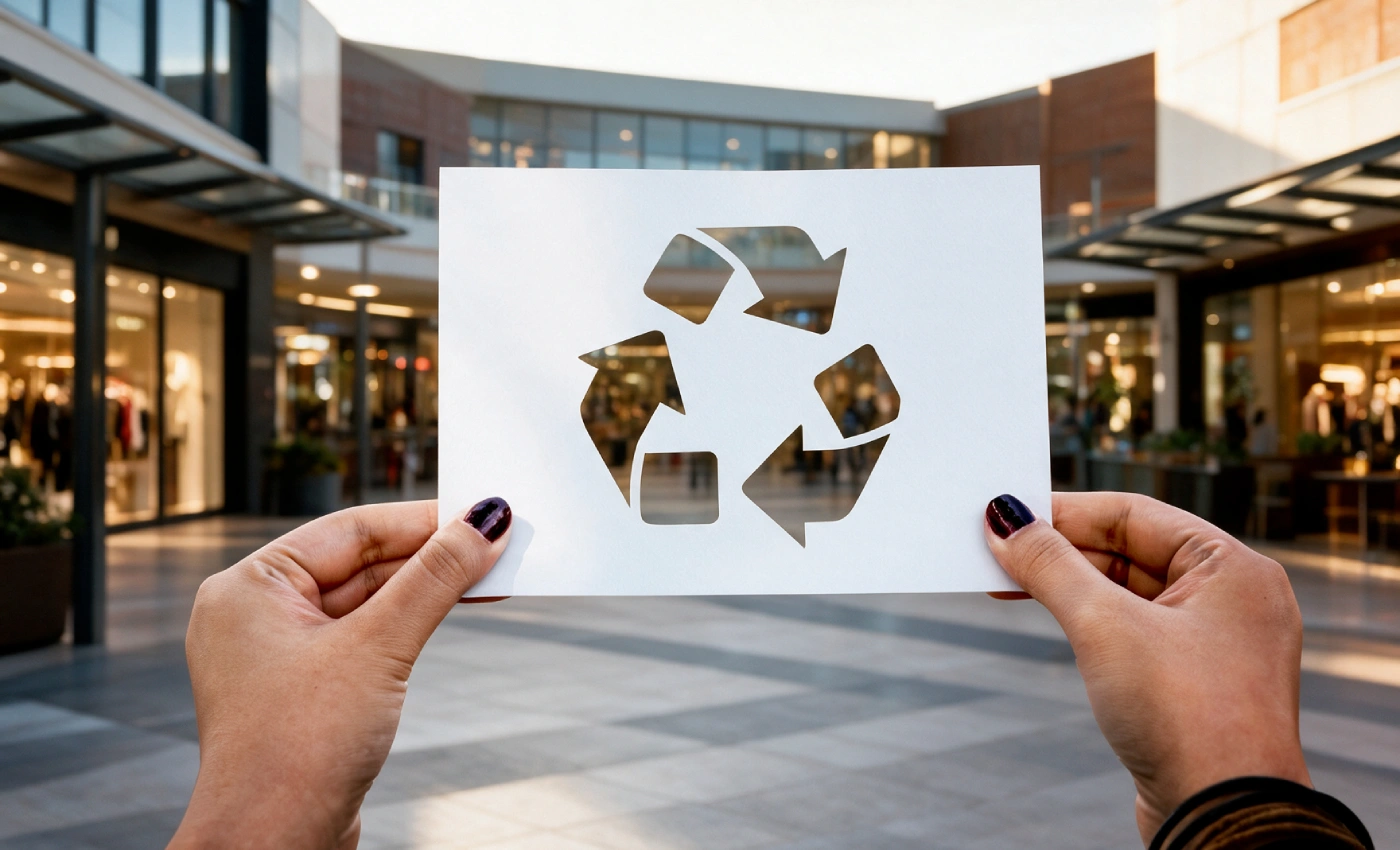
Driving this transformation is technology, which has now evolved from a simple optional tool into the central driver of sustainability on the construction site. On the one hand, there is Artificial Intelligence, an invisible mind capable of anticipating waste before work even begins.Thanks to predictive software, it is possible to accurately estimate material quantities, avoiding excess orders and unnecessary waste. AI also optimizes activity scheduling and workforce deployment, reducing downtime, repeated work and unnecessary consumption.
On the other hand, 3D printing is revolutionizing the production of structural and decorative elements. Creating complex shapes using only the material actually needed reduces waste generated by traditional manufacturing processes and, in many cases, limits transportation and on-site activities.
Technology thus becomes a strategic ally for the general contractor: it optimizes resources, reduces waste and coordinates processes with precision. And efficiency does not stop at the construction site. Those managing the project must ensure supply chain traceability (from the origin of materials to recycling percentages) and monitor the store’s energy performance through sensors and IoT systems. For brands, this means conceiving the retail space as a system to be monitored and continuously improved over time. Sustainability is no longer just a statement; it becomes a measurable performance, capable of generating value.
Because today, a successful store is not simply one that looks good, but one that can demonstrate, data in hand, that it is efficient and responsible.
SOURCES
• https://trellis.net/article/4-sustainable-construction-trends-2026/
• https://cmicglobal.com/resources/article/Top-Trends-in-Retail-Construction