






In the retail construction landscape, there are two fundamental approaches to managing a project: General Contractor (GC) and Construction Management (CM). Understanding the differences between these models is essential to make the most strategic decision for your commercial project.
The General Contractor represents the traditional “turnkey” model: a single company takes full responsibility for the project, from design to final delivery. The client signs only one contract and has a single point of contact throughout the duration of the work. The GC internally coordinates all subcontractors, manages materials, and ensures compliance with agreed timelines and costs through a fixed price.
Construction Management, on the other hand, is an in-house approach where the owner retains direct control over all phases of the project. The Construction Manager acts as a consultant and coordinator, but the client maintains separate contractual relationships with each subcontractor and supplier. This model offers greater transparency regarding actual costs but requires more active coordination and involvement from the owner in operational decisions.
The Italian Retail Market in 2025: Outlook and Opportunities
The Italian retail sector is experiencing a phase of strong growth, with investments nearly reaching €10 billion in 2024, a 50% increase compared to the previous year. The beginning of 2025 confirms this positive trend, with retail accounting for 25% of total investment volumes, a sharp rise from 10% in 2023. Italy’s construction market is projected to grow by 2.6% annually, reaching €111.64 billion in 2025. . This favorable environment creates significant opportunities for retailers and investors who are able to choose the construction model best suited to their needs.
Comparative Analysis: Advantages and Disadvantages
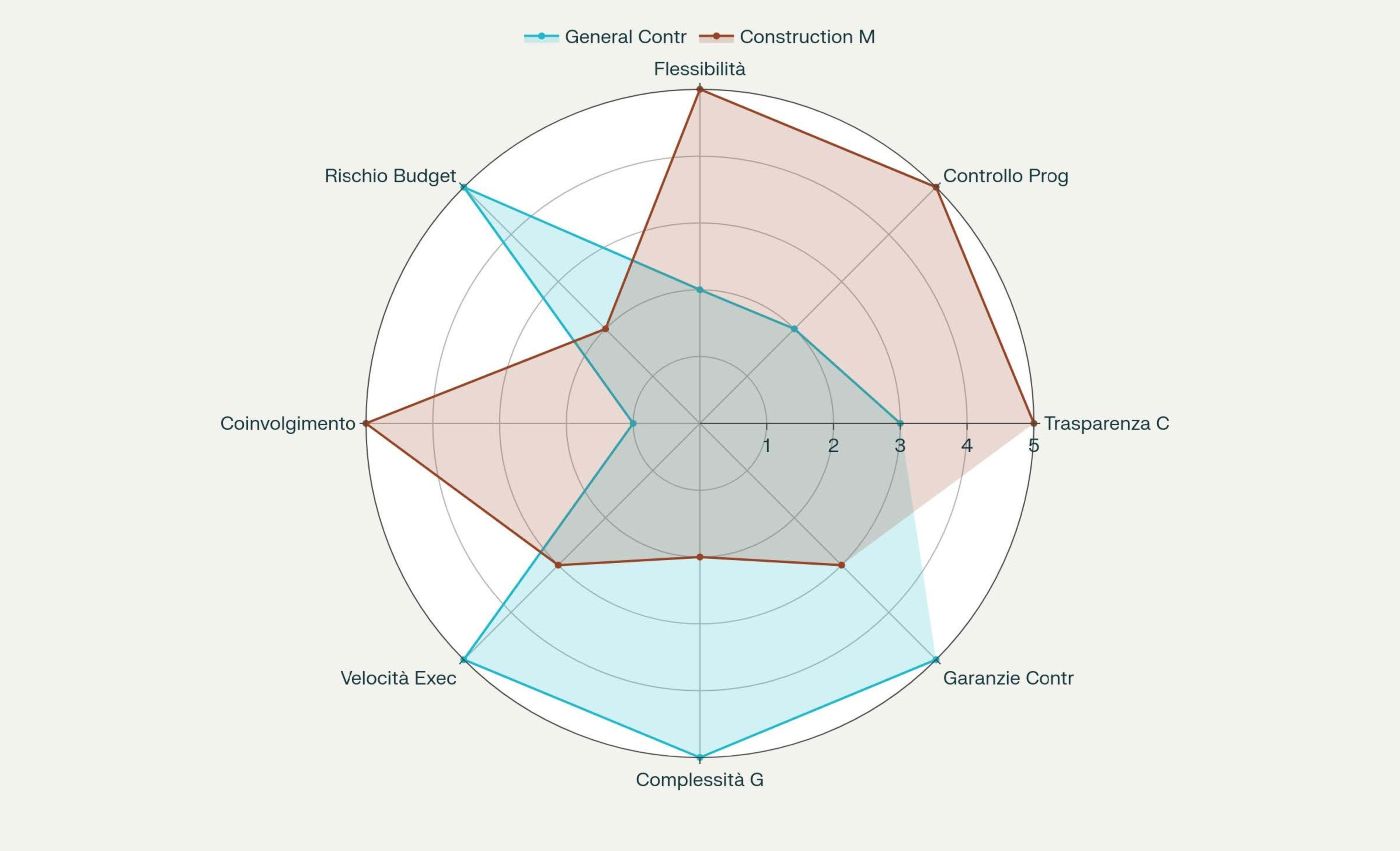
- “How much can the risk of budget overruns increase?”
- “How much client involvement/time is required?”
- “How high is the speed of execution compared to the company’s effort?”
- “How high is the management complexity on the client side?”
- “What level of contractual guarantees and responsibilities are offered to the client?”
- “How transparent are the costs and the breakdown of expenses?”
- “How much actual control does the client maintain over suppliers, materials, and work?”
General Contractor (GC):
- Single responsibility: One point of contact eliminates complexity and fragmented accountability.
- Guaranteed fixed price: Cost certainty with elimination of budget overrun risks.
- Execution speed: Optimized processes and specialized coordination reduce timelines by 15–25%.
- Integrated management: From bureaucracy to administrative procedures, everything is delegated to experienced professionals.
- Apparently higher costs: 10–25% markup for contractor overhead and profit.
- Lower transparency: Difficulty in verifying actual costs of materials and individual tasks.
- Limited flexibility: In-progress changes involve costly change orders.
Construction Management (CM):
- Full transparency: “Open book” approach with complete visibility into all project costs.
- Direct control: The owner retains decision-making power over the selection of subcontractors and materials.
- Design flexibility: Easier to manage changes without renegotiating the entire contract.
- Potential savings: CM fees are typically 25–50% lower than the GC’s markup.
- High involvement: Requires internal expertise and dedicated time for supervision.
- Shared risk: The owner bears responsibility for any cost overruns.
- Contractual complexity: Requires managing multiple contracts with various suppliers.
Factors that Influence the Choice
The decision between a General Contractor and Construction Management depends on several key variables.
The General Contractor is the ideal solution when starting with a fixed budget and wanting to avoid cost surprises, especially when the company lacks in-house expertise to directly manage a construction project. It is particularly effective when facing tight deadlines, where execution speed is critical, and for projects with clearly defined specifications, where no major changes are expected during construction.
Construction Management, on the other hand, is advantageous for those who want maximum control over costs and suppliers and have the internal resources to closely follow the project. This approach is preferable when flexibility is a priority or when a high level of transparency is required, such as for compliance needs or detailed reporting.
| Criterio | General Contractor | Construction Managment |
| Budget fisso richiesto | Ideale | Sconsigliato |
| Controllo costi prioritario | Limitato | Massimo |
| Competenze interne | Non necessarie | Fondamentali |
| Timeline aggressiva | Efficiente | Coordinamento difficile |
Practical Implementation by Segment
In the segment of pop-up stores and formats under €500,000, Construction Management allows for greater flexibility and quicker modifications, often making it the more advantageous option. For standard stores ranging from €500,000 to €1 million, the General Contractor offers the best balance between streamlined management and effective control over time and costs.
In the case of flagship stores or premium projects over €1 million, the choice primarily depends on internal capabilities: the General Contractor simplifies the process and offers protection, while Construction Management provides maximum control over materials and customizations. Finally, for large-scale retail chains, building internal capabilities with a CM approach can lead to more efficient project management and long-term cost savings. However, the decision always depends on the specific characteristics of the organization. Despite the advantages of CM, many companies still prefer to rely on a GC to reduce management time and simplify the process.

The Winning Strategic Choice
In the Italian retail market of 2025, marked by robust growth but intense competition, the choice between General Contractor (GC) and Construction Management (CM) is never neutral. Every week of delay in opening translates into lost revenue, and every design error results in significant additional costs. The General Contractor specialized in retail emerges as the preferred solution in most situations, offering the right balance between risk control, speed of execution, and management simplicity. A GC especially suitable for:
- Retailers without established experience in construction management.
- Projects with fixed budgets and non-negotiable timelines.
- Premium locations where quality and compliance are critical.
- Companies that want to focus their resources on their core business.
Construction Management remains valid for sophisticated operators with strong internal expertise and projects requiring extreme flexibility or granular control over costs. The final decision must always consider the opportunity cost of time spent managing the project versus focusing on commercial activities. In retail, where time-to-market often determines success, relying on an experienced General Contractor can make the difference between a winning launch and a missed opportunity. Today’s market conditions are favorable for investing in retail construction: choosing the right model is the first step toward project success. Construction Management proves advantageous for those who want maximum control over costs and suppliers and have the internal resources to closely oversee the project. This approach is preferable when flexibility is a priority or high levels of transparency are required, such as for compliance or detailed reporting needs.